Rabbits
Surprised by JoyRabbits hold two related places in C. S. Lewis’s account of childhood: they are among the anthropomorphized animals that first drew him into making stories, and they become citizens and rulers of Animal-Land, the imagined country developed alongside his brother’s India. Their progression from nursery figures to participants in a mapped history reveals how play became an elaborate act of world-building. Yet Lewis distinguishes imaginative invention from belief: Animal-Land mattered as a creation, not as a reality mistaken for the world outside it.
Early Drawings and Stories
Lewis recalls that he and his brother were incessantly drawing from a very early age, but their subjects already differed. His brother drew ships, trains, and battles; Lewis drew what they called “dressed animals,” the speaking and acting beasts of nursery literature. The contrast gave the brothers’ separate imaginative interests a visible form: one was drawn toward machinery and action, the other toward animal characters. Lewis’s account of their drawings also stresses their limitations. They had movement, comedy, and invention, but little sense of design or natural form; the animals belonged to imaginative play rather than careful observation of living creatures.
Lewis’s early stories joined two pleasures, dressed animals and knights in armor. The result was a company of chivalrous mice and rabbits riding out in complete mail—not to fight giants, but to kill cats. The reversal makes the scale and comic spirit of the stories plain: familiar animals were recast as figures in romantic adventure, while the ordinary threat of a cat supplied their heroic opposition. Rabbits were not just decoration in these tales; they could take the central role of armored protagonists.
Animal-Land and a Shared World
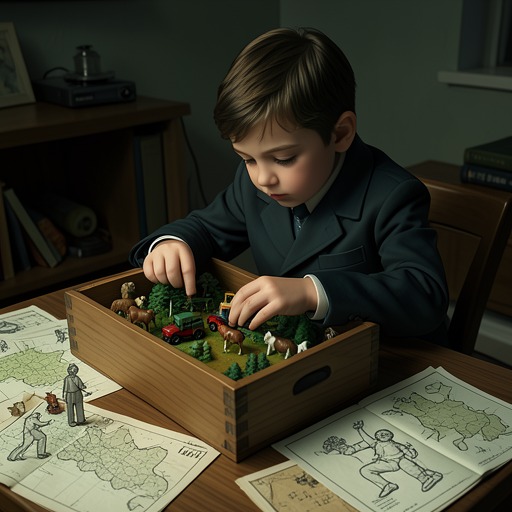
During holidays, when his brother was at home, Lewis’s Animal-Land became a modern country equipped with trains and steamships, so it could be shared with his brother’s India. The medieval Animal-Land of Lewis’s stories had to belong to the same place at an earlier period. That connection led him beyond isolated adventures toward a full history, an attempt to give the fictional country a past that could be related to its more modern form. Lewis admits he never carried this history forward to modern times: centuries were difficult to fill when the historian had to invent every event.
The history nevertheless shows a strikingly early interest in how invented stories become accounts of the past. Lewis recalled warning readers that the chivalric adventures in his history might be “only legends.” Even as a child, he had begun to distinguish epic material from historical certainty. From writing history he moved to geography, drawing several maps of Animal-Land that were, in his recollection, reasonably consistent. He then connected the country geographically with his brother’s India, which they relocated from its real-world position and made an island. The two lands, and the steamship routes between them, expanded into a larger mapped world populated by increasingly consistent characters.
King Benjamin VII
The rabbits of Animal-Land were not all interchangeable storybook figures. Lewis singles out the Seventh Benjamin, a rabbit king, as a rounded character whose appearance and history remained vivid in memory. He was the heaviest-jowled and squarest-built of rabbits; in later life he was very fat and dressed shabbily, in a loose brown coat and baggy checked trousers. The contrast between this unimposing appearance and his royal dignity is part of the character Lewis recalls: Benjamin could display a dignity that took disconcerting forms.
Benjamin’s ambition to be both king and amateur detective shaped his adventures. He pursued Mr. Baddlesmere, who turned out not to be a criminal but a lunatic—an unexpected complication that, Lewis jokes, would have confounded even Sherlock Holmes. The detective’s mistaken assumptions made Benjamin’s efforts comic without making him a nonentity. His career also brought repeated kidnappings, sometimes lasting for long periods and causing anxiety at court. On one return, Baddlesmere had dyed him, and the familiar brown rabbit reappeared as a piebald one; Benjamin then struggled to establish his identity. The episode makes bodily appearance consequential within the fictional world: those who knew the brown figure had to recognize a king whose coloring had changed.
Lewis leaves Benjamin’s political and personal merits unresolved. History, he says, cannot pronounce him either a good rabbit or a good king, but it can say that he was not insignificant—and that he ate prodigiously. This qualified judgment gives the remembered character more than a single comic trait. Benjamin’s detection, captivity, altered appearance, royal standing, and appetite accumulate into a life that feels particular, even though it belongs to an invented rabbit ruler.
Imagination, Memory, and Reality
Lewis presents Animal-Land as an extension of childhood collaboration, not as a world he or his brother believed to exist. Its inhabitants could acquire continuity, political histories, geography, and distinguishing traits because the children had made them. The distinction matters to Lewis’s account of imagination: elaborate invention did not erase the boundary between fiction and reality. The rabbit stories could be vivid and their history systematic without being mistaken for truth.
The memoir also sets a limit on how much of Animal-Land Lewis recounts. After naming Benjamin, he declines to summon every remembered inhabitant, observing that readers who have built worlds would rather tell their own, while others might be bewildered. He includes the country because omitting it would misrepresent the period, but stresses that it had no connection with Joy. Rabbits therefore belong to a specific strand of his childhood: the pleasure of making stories and sustaining a shared fictional world, distinct from the separate experiences of longing and delight that shape the memoir’s account of Joy.